
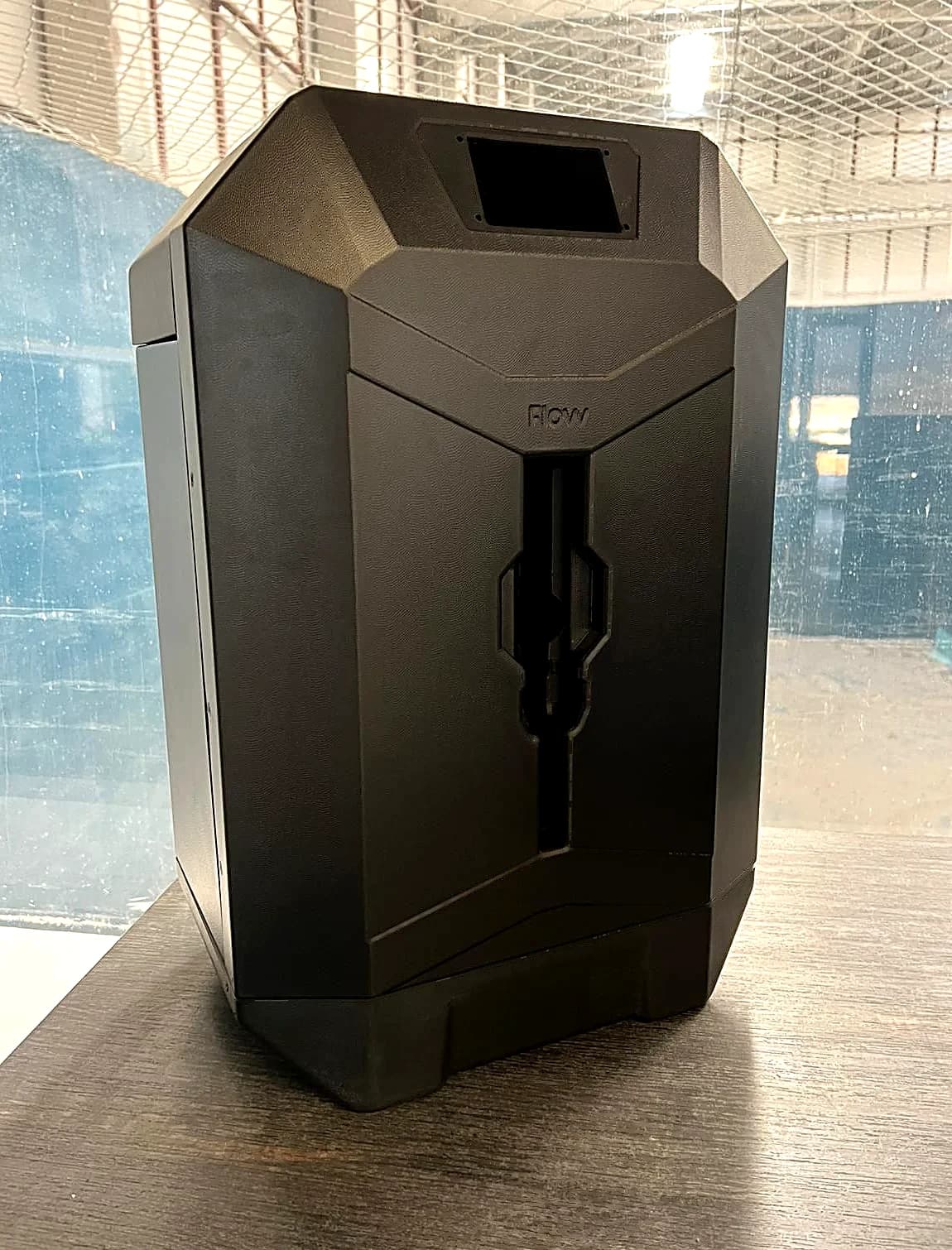
What is small-batch production?
Small-batch production is repeatedly making the same part in modest quantities — a recurring run of a fixture, an enclosure, a model, or an end-use component. Unlike a one-off prototype, the goal is consistency across the whole batch: same hardness, same cure, same finish, part after part. The metrics that matter on a run are batch consistency, cost-per-part, and throughput.
- Recurring runs of the same PU or resin part
- Made-to-order and just-in-time small quantities
- Parts where finish and dimensional consistency matter
Batch consistency: every pour starts the same
The single biggest threat to a production run is drift — the tenth part not matching the first. Hand-measured cups vary, and material poured by two operators (or the same operator on two different days) won't be identical. Flovv meters Part A and Part B at a fixed ratio and mixes them in-line, so each pour in the batch starts from the same blend. Less operator-to-operator variation means tighter hardness, cure, and finish across the whole run.
Cost-per-part: less scrap, less wasted material
Cost-per-part on a casting run is driven less by the headline material price than by rework and waste. Off-ratio or under-mixed parts get scrapped and re-poured, and leftover hand-mixed material can't be reused. By targeting the most common cause of rejects — inconsistent mixing — Flovv typically lowers the scrap rate, which is where the real per-part savings come from over a batch.
Throughput per pour
On a run, predictable pour-to-pour timing matters as much as quality. Because the measure-mix-pour steps are automated and identical each time, you can plan a steady cadence instead of stopping to re-weigh and hand-stir between parts. Standardize the shot volume, mold prep, and cure schedule, and each pour becomes a known quantity — which is what makes a batch schedulable.
Where hand mixing is still fine
If a "batch" is two or three parts, or the design changes every run, hand-mixing is reasonable and the gains from automation are small. Flovv earns its keep on repeatable runs of the same part, where consistency and reduced scrap compound across the batch.
Honest limitations
- Built for small-to-medium batches — not high-volume injection molding.
- Throughput is per-pour and per-mold; very large runs may eventually justify hard tooling.
- Bubble-critical clear parts may still need a vacuum step.
- Confirm material viscosity, pot life, and mix ratio before committing a production run.
Set up your run with the Flovv injection system. For the capability and equipment angle, see low-volume manufacturing; for material choice, see resin casting and polyurethane casting. Compare the workflow on Flovv vs. hand mixing, and browse materials and chemicals.