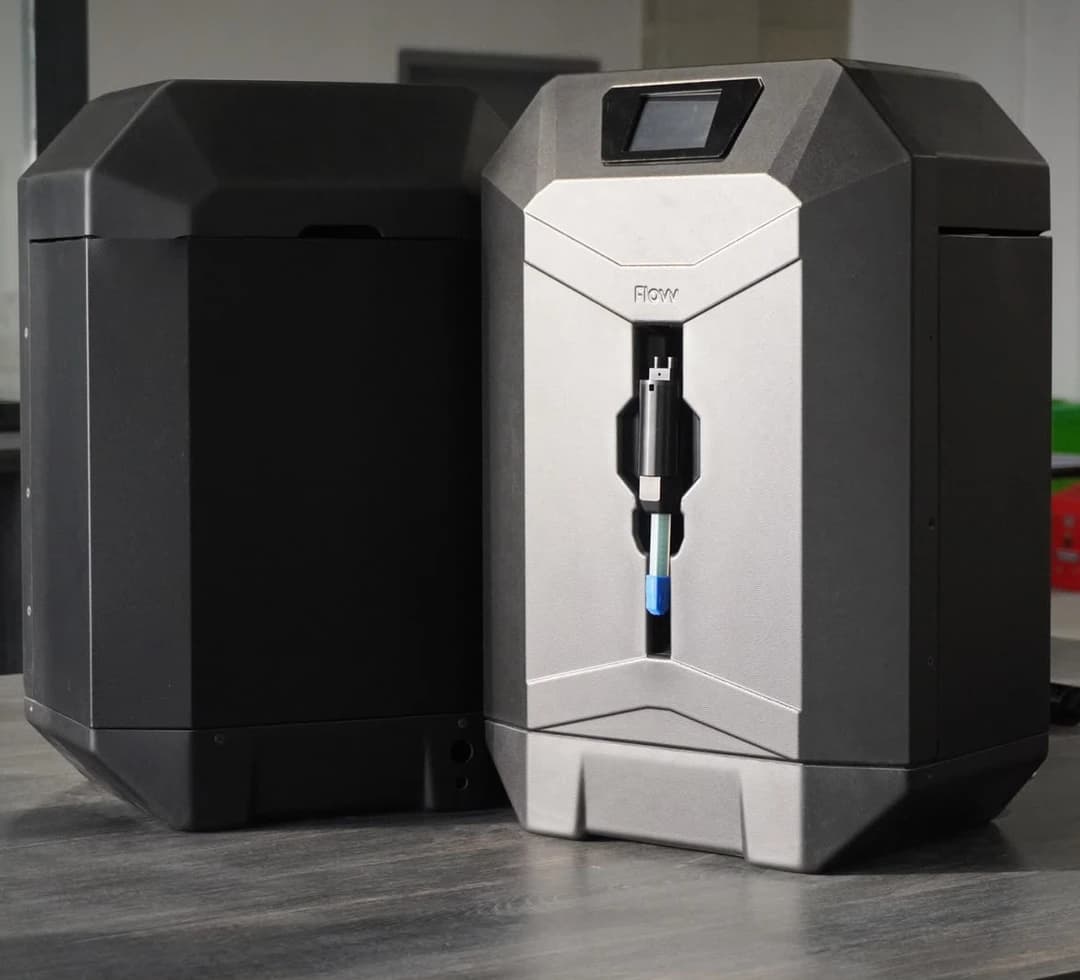
Making a mold has always been the slow part of casting. You model a part, then spend hours designing a mold around it — parting lines, a sprue, vents, alignment, draft — before you can pour anything. Flovv MoldLab collapses that step: upload a 3D file and it generates a ready-to-use mold automatically. Today we're adding a third way to make one.
What MoldLab does
Upload a STEP or STL file and MoldLab analyzes the geometry, works out how the mold should split, and builds the mold around your part — sprue, vents, and alignment included. You download the result and go straight to making parts. There's no CAD work in between, and every dimension is read in millimeters, so what you upload is what you get.
Three ways to make a mold
The same upload can become any of three mold types, so you can match the process to the part and the volume:
- Printed mold (direct). A rigid, 3D-printable mold you pour resin straight into. The fastest route from file to first cast — good for prototypes and simpler parts.
- Silicone mold kit. MoldLab generates printable master fixtures with registration keys; you pour silicone over them to make a flexible mold, then cast in that. Flexible molds release undercuts a rigid mold would trap, and one master makes many pulls.
- Aluminum CNC mold (new). MoldLab generates machinable mold plates — a cavity plate and a core plate — with a sprue, runner, and gate, leader-pin bores, ejector bores, and cooling channels. You send the files to a machine shop and get metal injection tooling for bridge and prototype runs.
To be clear about the CNC option: it produces prototype and bridge tooling, not a promise of production-grade, tight-tolerance molds. The generated plates are a strong starting point that a machine shop finishes and fits; we describe the tolerances and the honest limits in the included instructions rather than overselling them.
What's under the hood
A few features do the heavy lifting on every job:
- Automatic parting-axis analysis checks undercuts on all three axes and splits on the safest one — or you can pick an axis yourself.
- Print-bed auto-split cuts any mold piece bigger than your printer's bed into printable segments with dowel-pin seams, and includes the dowels as a separate print file.
- Material estimates tell you how much resin, silicone, or aluminum a job needs before you commit — down to a per-plate billet-and-machined-weight breakdown for CNC.
- An in-browser 3D viewer lets you inspect the generated mold before you download it.
- STL, 3MF, OBJ, and STEP downloads cover slicers, mesh tools, and CAD. (STEP is a faceted conversion meant for reference and CAM, not exact printing — print from the STL or 3MF set, which is exact.)
Pricing
Update (July 2026): MoldLab is now free for every Flovv owner — see the announcement. Everyone else can try the first 5 molds free (preview-only); after that it's $30/month with unlimited molds under fair use — no per-mold fees.
The best way to understand it is to run a part through it. Head to Flovv MoldLab, upload a file, and see the mold it builds — printed, silicone, or CNC aluminum.